
Every founder has an ideas graveyard.
Sometimes it is a Notion page. Sometimes it is a Google Doc. Sometimes it is a Slack channel called #ideas. Sometimes it is 47 browser tabs, three screenshots on your desktop, and a random voice note you recorded at 1:13 AM because you were sure you had just discovered the next big product angle.
At first, it feels productive.
You save a Reddit thread. You paste a competitor pricing page. You screenshot a complaint from a user review. You write down a feature idea. You tell yourself, "This might be useful later."
Then later never comes.
Six months pass. The Notion page is still there. The links are still there. The screenshots are still there. But nothing happened.
No product decision. No roadmap change. No landing page test. No sales angle. No outreach message. No new feature.
The research was stored, but it was never activated.
That is the problem.
Market research is not a storage problem.
It is an activation problem.
Saving a link is not market research
A lot of founders confuse collecting with understanding. They see a useful Reddit thread, a competitor launch, or someone complaining about an existing tool, and they save it. That feels like research.
But most of the time, it is just hoarding.
The saved link has no context, no priority, no score, and no next action. It has no connection to the product, the roadmap, or the customer segment. So it sits there as a dead signal. This is how useful market intelligence becomes digital clutter.
The problem is not that founders are lazy. The problem is that the workflow is broken.
Founders are busy. They are building, selling, fixing bugs, replying to customers, checking analytics, thinking about pricing, dealing with support, and trying not to lose momentum. So when research gets dumped into a static notes app, it quietly disappears.
Not because it was useless.
Because it had no system pulling it back into the work.
The founder brain is not a database
Founders often think they will remember why they saved something.
You paste a Reddit link into a document and think, "This is obviously important. I'll know what this means later." Then you come back three weeks later and have no idea why it mattered.
Was it a customer pain? A competitor gap? A pricing clue? A feature request? A positioning angle? A sales objection? A trend? A warning sign?
The link alone does not tell you. A screenshot alone does not tell you. A copied comment alone does not tell you.
The missing piece is interpretation.
Without interpretation, market signals decay fast. That means every signal needs more than a source. It needs meaning.
Why static research docs fail
Most founder research systems fail in the same boring ways.
They store information, but they do not help you decide what to do next.
1. There is no context
A Reddit post saying "I hate using this tool" might be useful.
But useful for what?
Is it about onboarding, pricing, missing features, bad support, slow performance, confusing UX, or a niche use case? Without context, the signal is too vague to act on.
A better version looks like this:
Source: Reddit thread
Signal type: Pain point
Audience: Solo founders
Topic: Competitor onboarding
Meaning: Users are confused before reaching the first success moment
Potential action: Test a simpler onboarding flow in our product
Now the signal has a job.
It is not just a link. It is evidence connected to a product decision.
2. There is no priority
Not every signal deserves your attention.
Some complaints are loud but rare. Some competitor moves look scary but do not matter. Some feature requests sound interesting but only affect a tiny group of users.
Static notes treat everything the same. A tiny comment and a major recurring pain point both become just another bullet in a document.
That is dangerous.
Because if everything is saved equally, nothing is prioritized.
You need a way to separate interesting but weak signals from repeated customer pain, urgent competitor threats, high-intent buying signals, roadmap-worthy opportunities, and noise that should be ignored.
A good research system does not just store signals.
It ranks them.
3. There is no workflow
This is the biggest one.
Most saved research has no next step. A founder saves a link and moves on, but the signal is never turned into a feature ticket, landing page angle, customer interview question, sales reply, pricing experiment, roadmap discussion, or competitor positioning update.
So the research never becomes action.
This is why the Notion page becomes a graveyard.
It captures ideas.
It does not move them.
Market signals need scores, not folders
The classic solution is organization.
Create folders. Create tags. Create sections. Create a better Notion template.
That helps a little, but it does not solve the real problem.
A better folder system still does not tell you what matters. What you need is scoring.
A scored signal answers questions like:
- How strong is the evidence?
- How urgent is the pain?
- How often is this appearing?
- How close is this to our target customer?
- How connected is this to our product?
- How likely is this to create revenue?
- How hard would it be to act on?
- Is this a one-off complaint or a pattern?
That changes the entire workflow.
Instead of asking, "Where did I save that link?"
You ask, "What are the strongest opportunities this week?"
That is a much better question.
What a raw signal looks like
A raw signal is messy.
It usually looks something like this:
Source: Reddit link

"Does anyone know a cheaper alternative to [Competitor]?"
Useful?
Maybe.
But not yet.
At this stage, it is just a clue. It needs to be processed.
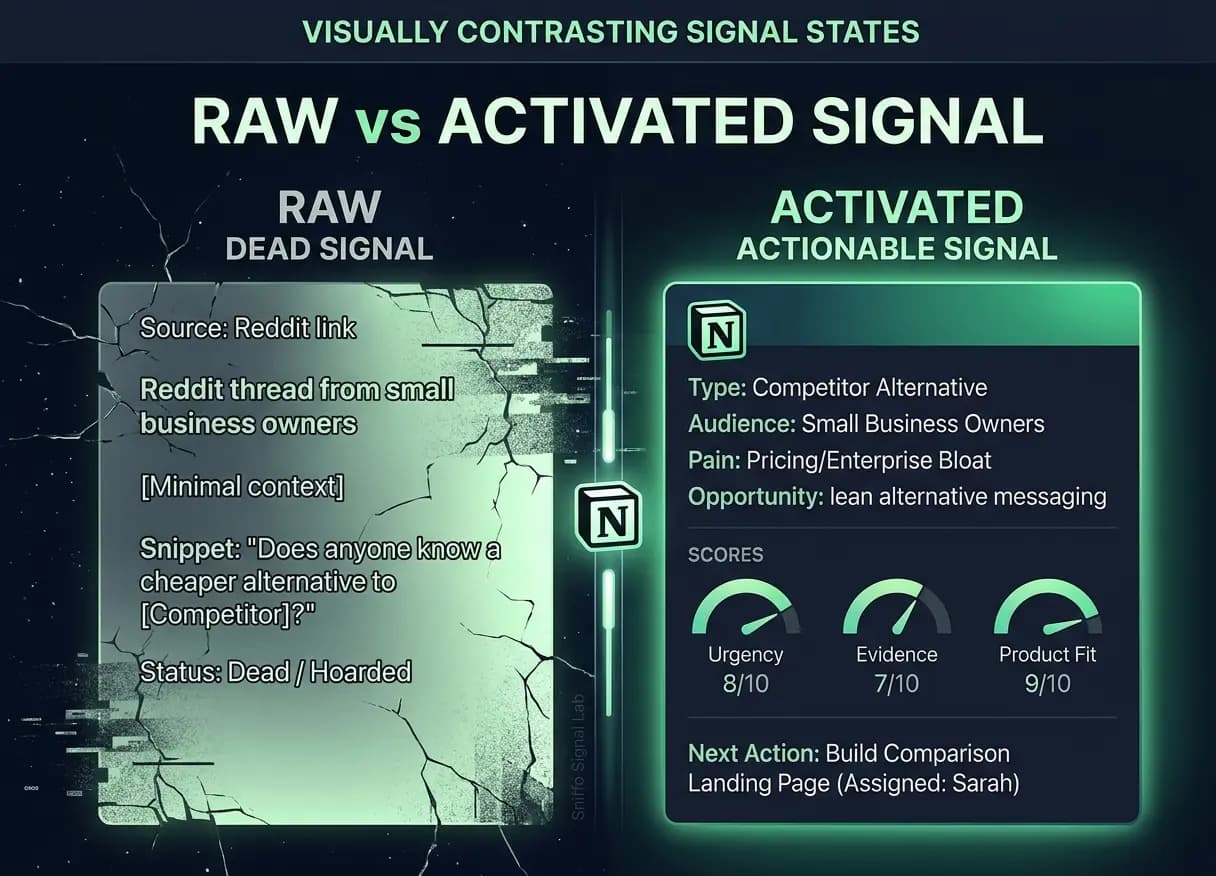
What an activated signal looks like
An activated signal looks more like this:
Type: Competitor alternative request

Source:
Reddit thread from small business owners

Pain:
Users like the competitor's feature set, but pricing feels too high for smaller teams. Several comments mention paying for features they do not use.

Opportunity:
Position our product as a simpler, leaner alternative for small teams that want the core workflow without enterprise bloat.

Scores:
Urgency: 8/10
Evidence: 7/10
Product fit: 9/10

Suggested action:
Create a comparison landing page and test messaging around "simpler alternative for small teams."
Now you have something useful.
Not just an interesting link.
A real opportunity.
This is the difference between collecting data and building intelligence.
The best founders do not just collect signals
They build a signal engine.
A signal engine is a system that takes messy outside information and turns it into product, marketing, and sales decisions.
It does not need to be complicated. At a basic level, it should do five things.
1. Capture the source
Every signal should keep the original source.
That could be a Reddit thread, competitor page, product review, support ticket, sales call note, community post, social media comment, changelog, pricing page, or even a job post.
The source matters because it keeps the signal grounded. Without the source, you are just trusting your memory.
And founder memory is not always reliable when everything is moving fast.
2. Classify the signal
A signal needs a type.
For example:
- Pain point
- Feature request
- Competitor weakness
- Competitor strength
- Pricing clue
- Audience segment
- Positioning angle
- Sales objection
- Trend
- Retention risk
Classification helps you see patterns.
If you have 30 saved items and 18 of them are pricing complaints, that tells you something. If 12 signals point to the same missing feature, that tells you something. If several users describe the same pain in different words, that tells you something.
But you only see that pattern if the signals are classified.
3. Add interpretation
This is where the real value lives.
A signal should answer one simple question:
What does this actually mean for us?
Not every complaint matters. Not every trend fits your product. Not every competitor move deserves a reaction.
Interpretation turns noise into judgment.
For example:
This is not really a feature request. It is a sign that users do not understand the setup process.
That one sentence can save you weeks.
Because without interpretation, you might build the wrong thing.
4. Score the opportunity
Scoring forces clarity.
It makes you decide whether a signal is actually important.
You can keep the scoring simple:
- Urgency: 1–10
- Evidence strength: 1–10
- Product fit: 1–10
- Revenue potential: 1–10
- Effort: 1–10
This does not have to be perfect. The point is not mathematical purity.
The point is to stop treating every saved idea like it has the same weight.
5. Attach a next action
Every strong signal should have a next action.
For example:
- Create feature ticket
- Add to roadmap discussion
- Write comparison page
- Test landing page copy
- Prepare outreach message
- Ask about this in customer interviews
- Monitor for more evidence
- Ignore for now
This is the step most founders skip.
But it is the step that turns research into momentum.
The hidden cost of passive knowledge hoarding
Passive research feels harmless.
It is not.
First, it creates false confidence. You feel like you are doing research because you are saving things. But if nothing gets scored, compared, or acted on, the research is not helping.
Second, it slows decisions. When everything is scattered, you cannot quickly answer the questions that matter: What are users complaining about most? Which competitor weakness keeps appearing? What should we build next? What should we test in our messaging? Which audience segment is showing the strongest pain?
Third, it makes your roadmap weaker. You start prioritizing based on memory, emotion, or whoever shouted last. That is how teams end up building features that feel logical internally but do not match the market.
Fourth, it wastes valuable signals. A single Reddit complaint may not matter. But ten similar complaints across three communities absolutely might. If those signals are scattered across notes, docs, tabs, and screenshots, you never see the pattern.
Static notes are where ideas go to feel safe
This is the uncomfortable part.
Sometimes founders save ideas because saving feels safer than deciding.
A saved idea does not force a tradeoff. A saved competitor screenshot does not force a roadmap change. A saved Reddit thread does not force a positioning decision.
It just sits there and gives you the feeling that you captured something.
But startups do not win by capturing everything.
They win by deciding faster and learning faster.
That means your research system should create pressure. Good pressure.
The kind that says:
- This signal is strong. Act on it.
- This signal is weak. Ignore it.
- This signal is interesting. Watch it.
- This signal keeps repeating. Prioritize it.
That is what a signal engine does.
It helps you stop hiding inside your own research pile.
A simple weekly signal workflow
You do not need a huge process.
You need a repeatable one.
Monday: collect signals
Pull in new market signals from your main sources: Reddit, competitor websites, product reviews, communities, support messages, sales calls, customer feedback, social media, and newsletters.
Do not overthink yet. Just capture what looks relevant.
Tuesday: classify and summarize
Turn raw items into structured signals.
For each one, answer:
- What happened?
- Who said it?
- What pain or opportunity does it reveal?
- What product area does it connect to?
Wednesday: score
Score the strongest signals.
You do not need to score everything. Focus on the ones that could affect product, sales, or marketing.
Use simple scoring:
- Urgency
- Evidence
- Fit
- Revenue potential
- Effort
Thursday: choose actions
Pick the highest-value signals and attach actions.
For example:
- Add to roadmap
- Write a comparison article
- Create a sales email angle
- Improve onboarding
- Monitor competitor pricing
- Interview 5 users about this pain
Friday: review patterns
Look for repeated themes.
Ask:
- What keeps showing up?
- Which pain is getting louder?
- Which competitor weakness is becoming obvious?
- Which idea looked exciting but has weak evidence?
This turns research into a rhythm.
Not a graveyard.
Why this matters more now
AI has made it easier than ever to collect and summarize information.
That is useful.
But it also creates a new problem.
Founders can now generate even more notes, summaries, ideas, and research documents than before. More information does not automatically create better decisions. In fact, it can make things worse.
If your AI workflow just creates bigger documents, you have not solved the problem.
You have created a larger graveyard.
The real advantage is not AI summarization.
The real advantage is structured signal processing.
AI should help you extract the pain, identify the audience, classify the signal, find repeated patterns, score urgency, suggest actions, and connect research to your roadmap.
That is where the leverage is.
Not in having 100 saved links.
In knowing which 5 actually matter.
From notes app to opportunity system
A notes app is passive.
A signal engine is active.
A notes app stores what you found. A signal engine tells you what it means.
A notes app waits for you to remember. A signal engine brings the strongest opportunities back to the surface.
A notes app is a shelf.
A signal engine is a filter.
That difference matters.
Because founders do not need more places to dump information.
They need a system that helps them make better decisions with less chaos.
The real question
The next time you save a Reddit thread, competitor screenshot, or customer quote, do not ask:
Where should I put this?
Ask:
What decision could this improve?
That one question changes everything.
If the signal cannot affect a decision, it may not be worth saving.
If it can affect a decision, it deserves structure.
Give it a source. Give it a type. Give it context. Give it a score. Give it a next action.
That is how research becomes momentum.
Final take
Your messy Notion page is not evil.
Your Google Doc is not the enemy.
The real problem is passive knowledge hoarding.
Saving links feels productive, but it is not enough. A market signal only becomes valuable when it helps you decide what to build, what to test, what to say, or what to ignore.
That means the future of founder research is not bigger notes.
It is better scoring.
More context.
Clearer evidence.
Direct source links.
And workflows that turn messy market noise into real opportunities.
Because the goal is not to collect more ideas.
The goal is to find the ones worth acting on.